PEACE WORK IS UNION WORK! SAY NO TO NATO!

A NEW PLAN FOR FIGHTING BACK!
WFTU General Secretary Pambis Kyritsis

"It has become clear once again that the working class can only rely on itself."
WFTU President Mzwandile (Mike) Makwayiba
Upcoming Events
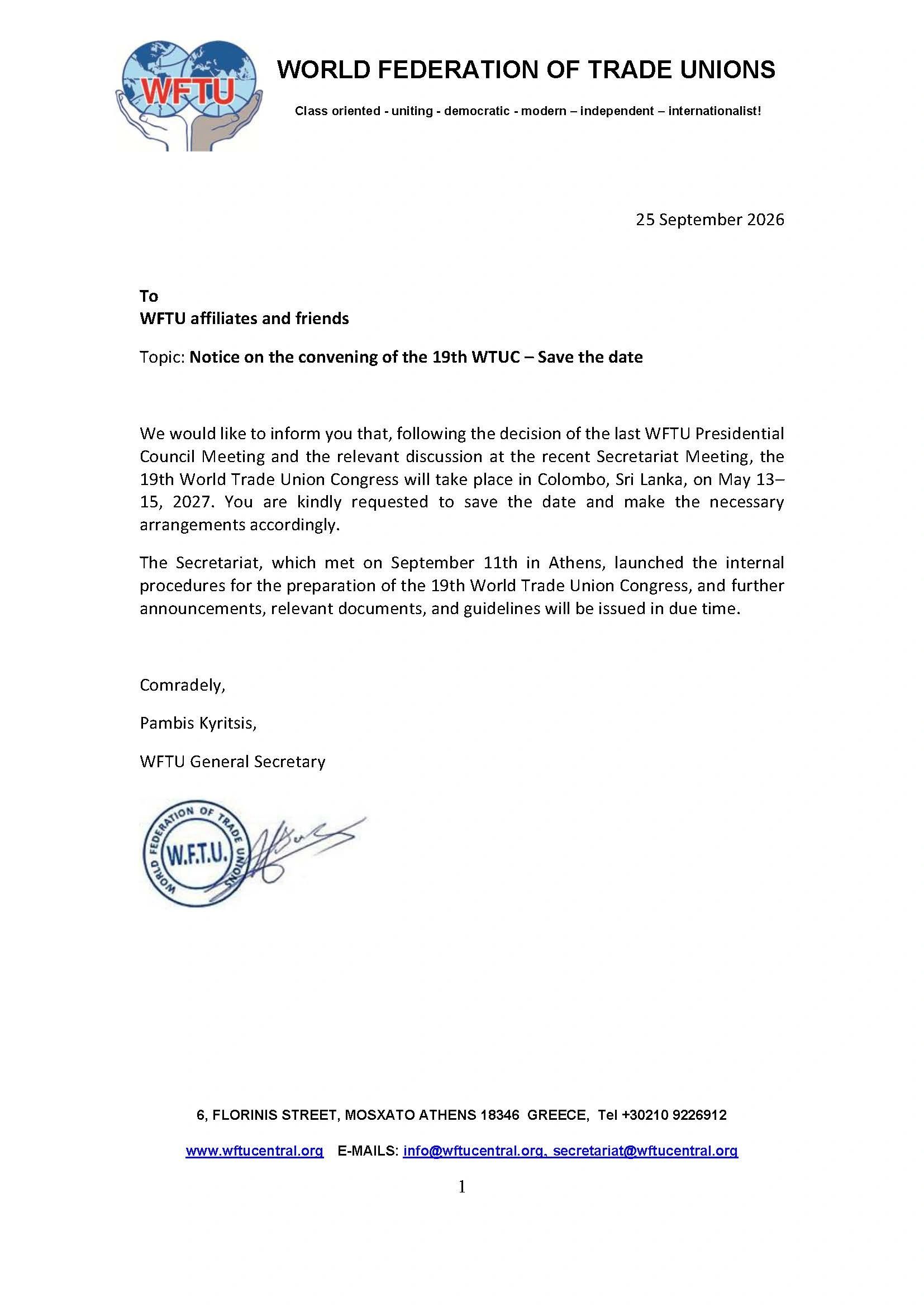
Join us for upcoming events. The World Congress of Trade Unions is taking place in Colombo, Sri Lanka from May 13-15, 2027!
World Trade Union Congress
Colombo, Sri Lanka
May 13-15, 2027
DAYS OF ACTION & PLANNING FOR A BETTER WORLD
Thursday through Saturday
WFTU Asia-pacific news

Massive Flooding hits Napal Extensive damage and loss of life reported.
Report from the Asia - Pacific Regional Office of the WFTU. Click on the image on the left to view the report.
Contact Us
Have a question or comment? We'd love to hear from you. Get in touch with us via email: editor@labortoday.international or phone: (323)239-6335
About Labor Today International

Our Mission
Consider becoming a Sustainer
Our Mission
At Labor Today International, we are committed to advocating for the rights and well-being of trade unionists and the non-represented workers. Through collective bargaining, we strive to secure fair wages, safe working conditions, and access to quality benefits.
Our History
Consider becoming a Sustainer
Our Mission
Founded in 2016, Labor Today International has a long history of fighting for workers' rights in various industries. From organizing strikes to lobbying for legislation, we have always been dedicated to protecting the interests of our members. Currently we are working on the campaign for a tax on billionaires in California, promoted by th
Founded in 2016, Labor Today International has a long history of fighting for workers' rights in various industries. From organizing strikes to lobbying for legislation, we have always been dedicated to protecting the interests of our members. Currently we are working on the campaign for a tax on billionaires in California, promoted by the Service Employees International Union (SEIU). Be sure to vote YES on Tuesday, Nov. 3.

Consider becoming a Sustainer
Consider becoming a Sustainer
Consider becoming a Sustainer
By donating to Labor Today International, you gain access to information you won't find anywhere else: from India to Greece, from France to Italy and Spain, from Portugal and México, to Brazil and Argentina, from Perú to Columbia and Cuba. We cover the world with articles about class oriented, militant trade unionism. In the United State
By donating to Labor Today International, you gain access to information you won't find anywhere else: from India to Greece, from France to Italy and Spain, from Portugal and México, to Brazil and Argentina, from Perú to Columbia and Cuba. We cover the world with articles about class oriented, militant trade unionism. In the United States we cover the developments on the railroads. Read all about the fight against the mega-merger between Union Pacific and Norfolk Southern railroads. It's all here, and more!
SUPPORT AMTRAK!
SUPPORT THE ALL ABOARD ACT!
S.2025 WILL:
FULLY FUND AMTRAK SO THAT AMTRAK CAN BUY NEW ROLLING STOCK AND LOCOMOTIVE EQUIPMENT, HIRE MORE EMPLOYEES & PROVIDE SERVICE TO MORE AREAS OF THE COUNTRY.
CALL YOUR U.S. SENATORS AND TELL THEM TO SUPPORT THE ALL ABOARD ACT: S. 2520 CAPITOL SWITCHBOARD: (202) 224-3121 THEY WORK FOR YOU!

Public Rail Now Statement on Proposed NS–UP Merger

Re-Regulation or Renationalization
Kill the Mega-Merger
News and Updates
Public Rail Now has a multitude of concerns with the proposed merger of two gigantic rail corporations. Our position is currently one of hesitation and cynicism that this is a merger to benefit the public and is more about mass congealing of private capital consolidating power to benefit a few. The proposal will not only put rail workers in the crosshairs of shareholder profits, but also risk the safety of trackside communities in the name of cost-cutting. It will exploit shippers and downgrade the already sad service the freight rail industry is touting they provide.
While we think there is a benefit to having an efficient coast to coast freight rail network, we are not optimistic this merger bodes well for anyone but the shareholders. This is a public interest crisis: this is about control of essential infrastructure, not just about corporate mergers. This merger opens the opportunity to discuss:
- Re-regulation – Trying to patch the broken system of private ownership with stricter rate controls, service obligations, labor protections, and safety rules — but still leaving railroads in the hands of Wall Street.
- Renationalization (Public Ownership) – Taking the rail network back into democratic, public control so that decisions about service, safety, and labor are made for the public good, not quarterly earnings.
The Monopoly Problem:
The U.S. rail system has been reduced to a regionally fragmented duopoly, where chronic short staffing and safety compromises put workers and communities at risk, service for small shippers is unreliable, trains are excessively long, and consumers ultimately pay the price. The Staggers Rail Act of 1980 deregulated most of the freight rail industry, allowing railroads to set rates and abandon service with minimal government oversight. Before Staggers, there were 40 Class I freight railroads; today there are only six.
For over a decade, rail carriers have embraced “Precision Scheduled Railroading” (PSR) — corporate shorthand for running fewer, longer trains with fewer workers to lower the operating ratio and boost profits. Since PSR’s rise in 2012, the rail workforce has been slashed by 17%, less-profitable lines and service stops have been cut, and communities have lost access to essential freight service. Profits have soared — but instead of investing in infrastructure upgrades, expanding service, or transitioning to cleaner Tier 4 or electrified yard locomotives in marginalized communities, the Class I railroads have funneled cash to shareholders. From 2010 to 2020, they spent $196 billion on stock buybacks, ignoring a 2007 Association of American Railroads study calling for $135 billion in capacity expansion to meet 2035 demand.
Now, in a repeat of this pattern, rail executives are eyeing an $85 billion Norfolk Southern–Union Pacific merger — even as the recent Canadian Pacific–Kansas City Southern merger cost $31 billion. The consequences are predictable: more job cuts, more de-skilling, more service cuts, and more unsafe cost-cutting, all while shareholder profits soar. This merger is not about building a stronger national rail network — it’s about concentrating private wealth and power. Which brings us to the real question for the public: Will we keep trying to patch this broken private monopoly system with limited re-regulation, or will we finally reclaim our railroads under public ownership, where service, safety, and jobs come before shareholder dividends?
Impacts on Railroad Workers:
The consolidation of 40 Class 1s into 6 regional monopolies have left the rail working labor force in shambles. In 1975 the rail industry employed about 500,000 workers. The deregulation of the industry after the Staggers Act was passed led to substantial reduction in the rail workforce. By the early 2000s, the rail industry employed 250,000. Currently the Bureau of Labor Statistics (if it can be considered reliable anymore) reports less than 153,000 for May 2025.
With this merger, we would expect the jobs cuts and de-skilling to continue in the face of crew reductions, automation, and contract labor outsourcing. All the above undermines safety, because experienced judgment is replaced with automated or scripted processes creating safety issues for the remaining workers and ultimately impacting trackside communities. The loss of railroaders equates to a reduction in union membership thus weakening collective bargaining power.
This Merger Demands Structural Change
The problem isn’t just this deal — it’s a system that allows a handful of private corporations to control critical national infrastructure, while shareholders and hedge fund managers fill their stock portfolios and bank accounts.
Current laws and regulations are incapable of protecting workers, shippers, passengers, or the public interest because they were enacted for a competitive market that no longer exists. After decades of mergers, the few remaining rail monopolies face no real competition. The STB and the FRA are both toothless and impotent to enact any beneficial change to a multi-billion dollar industry that is literally the foundation of the US economy.
In this environment, consolidation doesn’t just slip through the cracks — it flourishes. If regulators could not or would not stop the $31 billion Canadian Pacific–Kansas City Southern merger from further concentrating market power, there is little reason to believe they will protect the public from the far larger $85 billion Norfolk Southern–Union Pacific deal. Without structural change, this merger will simply accelerate the cycle of fewer jobs, worse service, higher rates, deferred maintenance, and greater risks for trackside communities — while delivering nothing but bigger payouts to shareholders.
This merger is a wake-up call: patching the current system with stricter rules will not solve the structural problem — a handful of private monopolies controlling essential infrastructure for profit. The real solution is public ownership, where the rail network is run for the public good, not quarterly earnings. A nationalized, democratically accountable rail system could restore service, protect workers, lower costs for shippers, and prioritize safety and climate goals. The choice is clear: keep trying to rein in the robber barons, or take the rails back.
PEACE IS UNION WORK!
Europe rallies in solidarity with Palestine

As bombing of Gaza by Israel continues for the second week without any pause, the people across Europe stepped up their solidarity initiatives with the people of Palestine and condemned the European states’ support of the war crimes committed by the apartheid regime in Israel
Boycott Chevron
There is a worldwide boycott of Chevron calling for an “immediate ceasefire” and an end to the “massacre in Gaza.”
Stay Informed

Stay up-to-date on Labor Today International's latest news and events by subscribing to our newsletter. You'll receive regular updates on our advocacy efforts, member stories, and more.